

The most expensive habit in your morning routine
For most supplement takers, the routine looks the same: kettle on, coffee poured, and the day's capsules swallowed with the first warm sip. It feels efficient. For at least one major nutrient, it is quietly throwing your money away — and the fix costs nothing but ninety minutes.
The science here is old, solid, and strangely under-publicized. Coffee does not blunt everything in your supplement drawer equally: it hits one mineral hard, nudges a couple of others, and leaves most of the rest alone. Knowing which is which turns a vague worry into a two-line schedule change.
Take the free supplement quiz →
---
Iron: the one coffee genuinely wrecks
If you take iron — or a multivitamin that contains it — this is the section that matters. In a classic absorption study, drinking coffee with a meal cut iron absorption by roughly 40 percent, and tea cut it by more than half (Morck et al., American Journal of Clinical Nutrition). Later work pinned down the culprit and the dose response: the polyphenols in coffee and tea — chlorogenic acid chief among them — bind non-heme iron in the gut into complexes your intestinal cells cannot take up, with iron absorption falling 50 to 90 percent as the polyphenol dose rises (Hurrell et al., British Journal of Nutrition).
Two details make this worse than most people assume. Adding milk does not soften the effect — the same research found milk had little or no influence. And the interaction is strongest exactly where it hurts most: supplemental and plant-based (non-heme) iron, the kind menstruating women, vegetarians, and anyone correcting a deficiency actually rely on (NIH Office of Dietary Supplements).
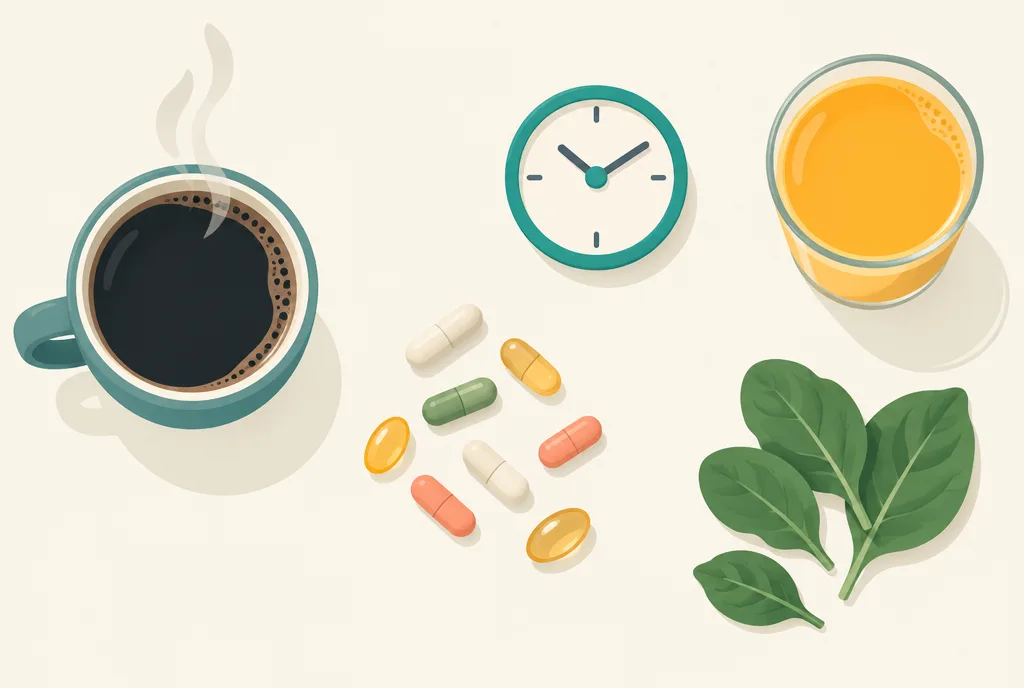
The fix. Separate iron from coffee and tea by at least 60 to 90 minutes on either side, and take it with vitamin C — ascorbic acid counteracts polyphenol binding and is the best-documented absorption enhancer for non-heme iron. A gentle chelated form such as ferrous bisglycinate with a glass of orange juice, mid-morning or before bed, beats an expensive iron pill chased with espresso every time.
---
Calcium and the minerals coffee only nudges
Caffeine has a reputation as a calcium thief, but the careful accounting says the theft is petty. Controlled studies found only a very small depressant effect on calcium absorption and no meaningful change in 24-hour urinary calcium — an effect fully offset by one to two tablespoons of milk (Heaney, Food and Chemical Toxicology). If your calcium intake is adequate, your latte is not the problem; if you supplement, just keep single doses at or under 500 mg for absorption reasons that have nothing to do with coffee (NIH ODS). Zinc and magnesium sit in the same category: minor, avoidable interactions rather than deal-breakers — and magnesium glycinate works better in the evening anyway, far from any reasonable coffee hour.
What coffee mostly leaves alone
The fat-soluble crowd — vitamin D3, K2, and omega-3 softgels — cares about one thing: being taken with a meal containing fat. Coffee alongside that meal is irrelevant. B vitamins and vitamin C are water-soluble and show no meaningful coffee interaction at normal intakes. Creatine users can also relax: the caffeine-cancels-creatine idea traces back to one small study and has not held up as a practical concern.
---
The timing cheat sheet
| Supplement | Coffee effect | What to do |
|---|---|---|
| Iron (and iron-containing multis) | Severe — absorption can drop 40–90% | Separate by 60–90+ min; pair with vitamin C |
| Calcium | Small | Take with food; keep doses at or under 500 mg |
| Zinc | Minor | Take away from coffee when convenient |
| Magnesium | Minimal | Take in the evening |
| Vitamin D, K2, omega-3 | None that matters | Take with a fat-containing meal, coffee or not |
| B vitamins, vitamin C | None at normal doses | Any time; morning is fine |
---
Two cautions worth reading
First, if you have diagnosed iron deficiency, the coffee gap is not a nice-to-have — it can be the difference between a ferritin number that climbs and one that stalls. Retest after 8–12 weeks of properly timed supplementation. Second, this article is about supplements, not medications: some prescriptions, thyroid hormone among them, have their own strict coffee and timing rules — those belong to your doctor and pharmacist, not a blog.
The bottom line
You do not have to choose between coffee and your supplements. Keep the coffee. Move the iron at least an hour away and pair it with vitamin C, let calcium ride along with meals in modest doses, push magnesium to the evening, and take your D3 and omega-3s with real food. Ninety minutes of separation preserves what the research says coffee would otherwise take.
Want to know which of these supplements are even worth your money in the first place? Our free quiz matches them to your diet, goals, and lifestyle.